
Article: What Makes a Safe Toddler Bed? 6 Things Parents Should Look For
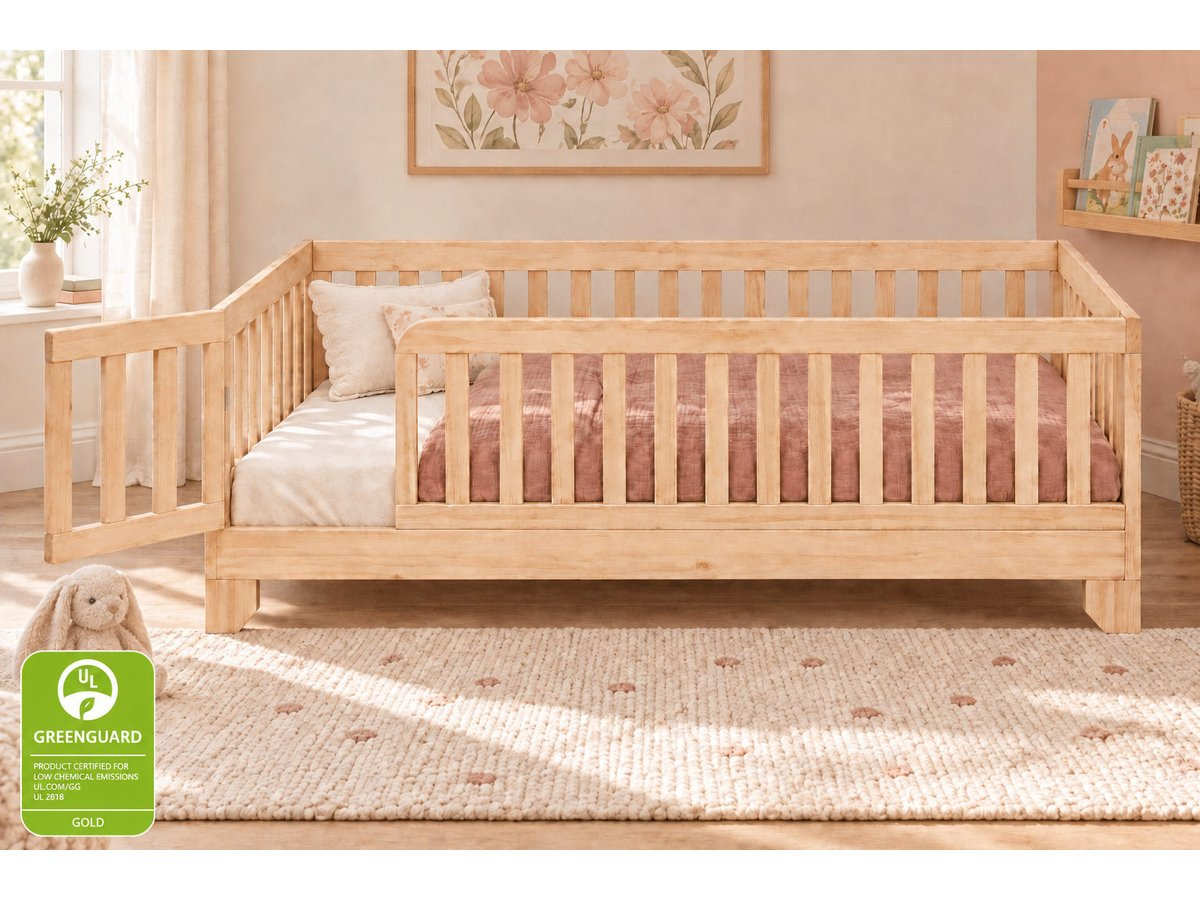
What Makes a Safe Toddler Bed? 6 Things Parents Should Look For
Choosing your toddler’s first bed can feel surprisingly complicated.
Should it sit directly on the floor? Does it need guard rails? How high should the rails be? What about the mattress? And how can you tell whether a bed that looks safe is actually thoughtfully designed?
For parents transitioning a child out of the crib, those are important questions.
The best place to start is not with color, style, or even whether a bed is labeled “Montessori.” Start with the design, construction, mattress fit, appropriate use, and the safety of the entire bedroom.
Here’s what parents should know when shopping for their toddler’s first big-kid

First: What Does “Safe Toddler Bed” Actually Mean?
There is an important distinction parents should understand.
The U.S. Consumer Product Safety Commission (CPSC) has a specific federal standard for products legally defined as toddler beds. Under that definition, a toddler bed is designed to accommodate a full-size crib mattress and provide free access and egress for a child who is at least 15 months old and weighs no more than 50 pounds.
The standard addresses hazards including openings, mattress-support systems, guard rails, sharp points and edges, small parts, wood components, corner posts, and potential entrapment areas.
Read the CPSC toddler-bed requirements →
However, many families today skip a crib-mattress-size toddler bed and move directly to a Twin, Twin XL, Full, or low-profile Montessori-style bed.
Those products should not automatically be assumed to meet the federal toddler-bed standard simply because the word “toddler” appears in their marketing.
That’s why parents should look beyond the product name and examine how the bed is actually constructed and tested.
What to Look for in a Toddler’s First Bed
| Feature | What to Look For | Why It Matters |
|---|---|---|
| Bed Height | A sleeping surface appropriate for your child's developmental stage | A lower sleep surface can reduce the distance of a potential fall |
| Guard Rails | Securely attached rails designed for the bed and intended mattress | Can help reduce rolling from the sleep surface |
| Openings & Spacing | Thoughtfully designed openings without obvious entrapment or pinch hazards | Poorly designed openings can create avoidable hazards |
| Mattress Fit | Correct mattress dimensions and thickness specified by the manufacturer | Mattress size and thickness affect gaps and usable guard-rail height |
| Construction | Sturdy frame, secure hardware and properly installed mattress support | Toddlers climb, bounce, lean and move differently than sleeping adults |
| Edges & Corners | Smooth, finished surfaces without hazardous sharp points or exposed hardware | Young children interact with furniture from every angle |
| Testing | Specific, verifiable testing appropriate to the product | Concrete testing information is more meaningful than vague “safe” claims |
1. Start With Bed Height
One of the biggest differences between a crib and a traditional bed is height.
A conventional bed frame can put the mattress considerably farther from the floor than the sleep environment your child is used to.
A low-profile bed reduces that distance and can also allow a mobile toddler to enter and exit the bed more independently.
This is one reason many families consider a Montessori-inspired floor bed for the crib-to-bed transition.
Low does not automatically mean safe, however.
The rest of the bed—and the room around it—still matters.
2. Look Carefully at the Guard Rails
Guard rails are one of the first features parents notice when shopping for a toddler bed.
But simply having rails doesn't tell you enough.
Look at:
- How securely the rails attach to the frame
- The height of the rails relative to the mattress
- The spacing and openings in the rail system
- Where the entry opening is located
- Whether there are potential pinch or entrapment areas
- Whether the manufacturer specifies an appropriate mattress thickness
For products covered by the federal toddler-bed standard, the CPSC requires the upper edge of the guard rail to extend at least five inches above the top of the mattress. The standard also includes strength requirements and provisions intended to address entrapment and strangulation hazards.
That does not mean “five inches” should be treated as a universal DIY rule for every Twin or Full bed. Instead, follow the instructions and mattress requirements for the specific bed you purchase.
3. Mattress Thickness Matters More Than Many Parents Realize
Parents often choose a bed first and mattress second.
For a bed with guard rails, those two decisions should be considered together.
Why?
Because increasing mattress thickness decreases the amount of guard rail that remains exposed above the mattress.
Imagine a guard rail that looks nice and tall with a thin mattress. Add a much deeper mattress and the effective rail height becomes significantly shorter.
Always follow the bed manufacturer’s mattress dimensions and thickness recommendations.
For the Luca Montessori Floor Bed with Rails, we recommend a 5–8 inch mattress. This helps maintain plenty of exposed guard rail while providing families with a range of mattress choices.
4. Pay Attention to Openings, Gaps and Entrapment Hazards
This is one of the most important—and most overlooked—parts of bed shopping.
The CPSC toddler-bed standard specifically addresses openings and potential entrapment areas because a child's head, neck, limbs or clothing can interact with furniture differently than an adult's.
When evaluating a bed, don't just look at the large entry opening.
Look closely at:
- Spaces between rails
- Spaces between the mattress and frame
- Connections between guard rails and side rails
- Spaces around the mattress-support system
- Corner posts and projections
- Areas where moving or removable components meet
This is also why parents should avoid modifying a bed or adding aftermarket rail systems unless specifically permitted by the manufacturer.
5. Choose Sturdy Construction
A toddler doesn't interact with a bed the way an adult does.
Children may pull on rails, lean against them, climb into bed from unusual angles and enthusiastically launch themselves onto the mattress.
Look for a bed with:
- A sturdy frame
- Securely attached guard rails
- A properly supported mattress platform
- Quality hardware
- Smooth wood components
- Clear assembly instructions
Once assembled, periodically inspect the bed and tighten hardware according to the manufacturer's instructions.
6. Don't Ignore Materials and Finishes
Your child may spend 10–12 hours a night in their bedroom, so it is reasonable to ask what their furniture is made from and how it is finished.
Look for specific information rather than broad phrases such as “eco-friendly” or “natural.”
Useful questions include:
- What material is the frame made from?
- What type of finish is used?
- Are paints or coatings tested for applicable requirements?
- Does the manufacturer provide specific certification or testing information?
7. Testing Matters—But Ask What Was Actually Tested
“Safety tested” sounds reassuring, but it is worth asking what that means.
Was the frame tested for structural strength?
Were materials or finishes tested?
Does the product have a specific certification?
Does that certification apply to the entire product, or only one component?
Specific information gives parents far more useful context than a generic safety badge.
Floor Bed vs. Traditional Toddler Bed vs. Standard Bed
| Feature | Crib-Mattress Toddler Bed | Low Twin/Full Floor Bed | Traditional Standard Bed |
|---|---|---|---|
| Typical mattress | Full-size crib mattress | Twin, Twin XL or Full | Twin, Full or larger |
| Sleep height | Usually low | Very low to low | Usually higher |
| Room to grow | Limited by crib mattress size and product limits | More sleeping space for later childhood | More sleeping space for later childhood |
| Independent access | Yes | Yes | Depends on bed height |
| Federal toddler-bed standard | Applies when product meets federal toddler-bed definition | Do not assume it applies; check product-specific information | Generally not a toddler bed under this definition |
The Bed Is Only Half of the Safety Equation
One of the biggest changes after leaving the crib has nothing to do with the bed itself.
Your toddler can now get up.
That means the bedroom effectively becomes part of their accessible sleep environment.
The American Academy of Pediatrics advises making a toddler's room as safe and hazard-free as possible when they move out of the crib. The CPSC also recommends anchoring furniture such as dressers and bookcases to help prevent tip-over injuries.
Read the AAP's big-kid-bed guidance →
Read the CPSC childproofing guidance →
Before the first night in a new bed, check:
- Dressers and bookcases: Secure furniture according to manufacturer instructions.
- Windows: Prevent unsafe access and don't rely on window screens to prevent falls.
- Blind and curtain cords: Keep cords inaccessible.
- Electrical cords: Check lamps, monitors and charging cables.
- Outlets: Childproof accessible electrical outlets appropriately.
- Climbing opportunities: Look at stools, toy boxes and furniture from a toddler's perspective.
- Small objects: Remove choking hazards and other inappropriate objects.
- Stairs and other rooms: Think about where your toddler could go if they leave the bedroom while you're asleep.
A safe first bed works best inside a thoughtfully childproofed room.
What About a Child Who Is Still Climbing Out of the Crib?
If crib climbing is what brought you here, don't ignore it.
The AAP's HealthyChildren.org advises transitioning a child to another bed when they reach approximately 35 inches tall or when the crib side rail is less than about three-quarters of their height. It also notes that falls frequently happen when children attempt to climb from cribs.
If your toddler has already started climbing, read our complete guide:
What to Do When Your Toddler Climbs Out of the Crib →
And if you're unsure whether it's time:
7 Signs It May Be Time to Transition From Crib to Toddler Bed →
How the Luca Is Designed for the Transition
These are many of the considerations that went into the design of our Luca Montessori Floor Bed with Rails.
The current Luca includes:
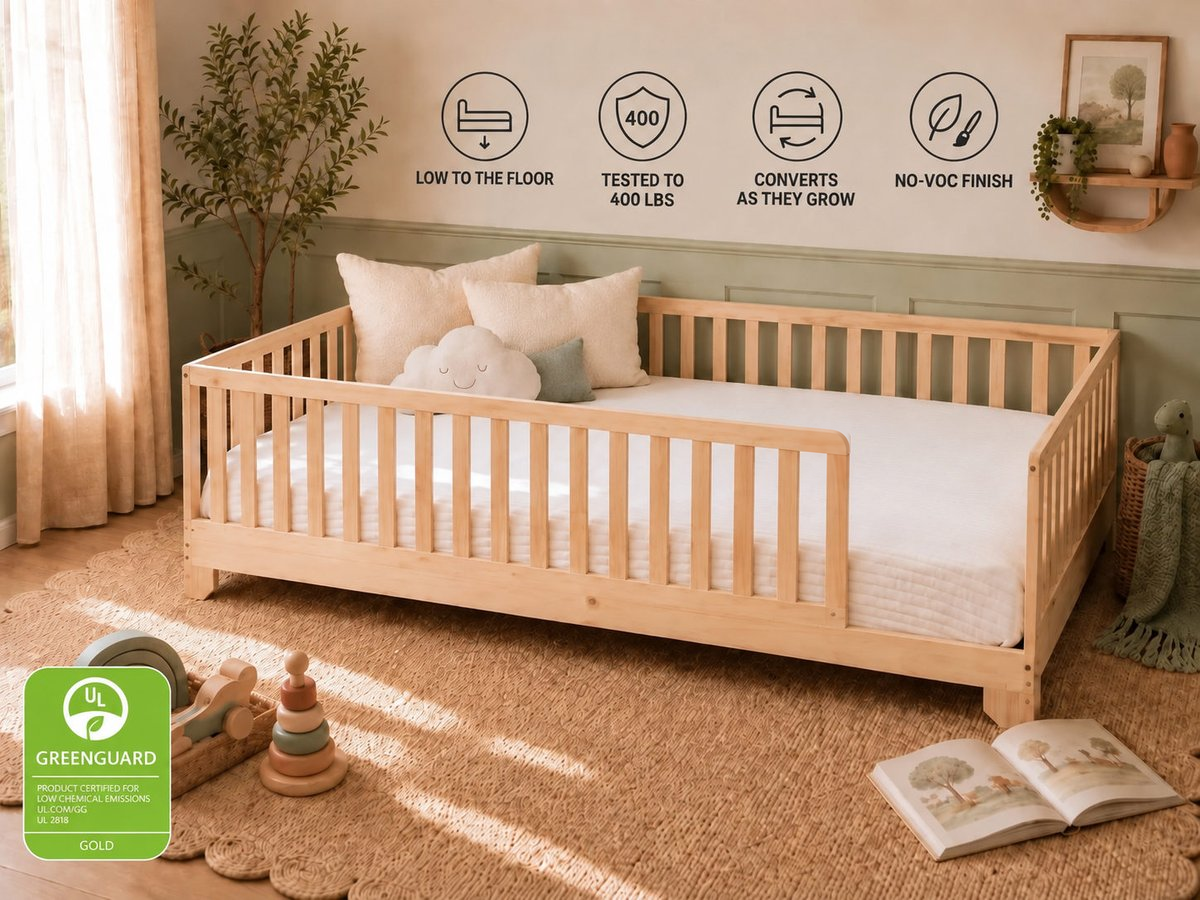
- Low-profile configuration for the crib-to-bed transition
- Guard rails on all four sides
- 2⅜-inch guard-rail spacing
- Open-entry or closing-gate configurations
- Solid furniture-grade pine construction
- Independently tested 400+ lb static weight capacity
- 5–8 inch recommended mattress thickness
- Water-based, no-VOC finish options
- Removable rails and removable 4-inch legs
- Twin, Twin XL and Full sizes
As your child grows, the rails and legs can be removed, allowing the bed to evolve beyond the initial toddler transition.
Explore the Luca Montessori Floor Bed with Rails →
A Toddler Bed Safety Checklist for Parents
Before choosing your child's first bed, ask:
☐ Is the bed appropriate for my child's age and developmental stage?
☐ Does the manufacturer clearly state the appropriate mattress dimensions and thickness?
☐ Is the sleep surface appropriately low for our needs?
☐ Are the guard rails securely attached?
☐ Have I looked carefully at openings and potential entrapment areas?
☐ Is the mattress properly fitted to the frame?
☐ Is the frame sturdy and properly assembled?
☐ Are the surfaces smooth and free from damaged wood or exposed hardware?
☐ Can the manufacturer explain what testing or certifications apply?
☐ Have I childproofed the entire bedroom?
☐ Have I anchored dressers and other appropriate furniture?
☐ Have I considered what my toddler can access if they get out of bed at night?
What Makes a Safe Toddler Bed? The Bottom Line
There isn't one feature that makes a toddler bed safe.
It's the combination of appropriate design, sturdy construction, thoughtfully designed rails and openings, correct mattress fit, proper assembly, product-specific testing and a childproofed bedroom.
And remember: “Montessori,” “floor bed,” and “toddler bed” are not interchangeable safety certifications.
Look beyond the label.
Ask questions. Read the manufacturer's instructions. Check the mattress requirements. Understand what testing applies. And evaluate the entire bedroom from the perspective of a newly independent toddler.
Because your child's first big-kid bed isn't just another piece of furniture.
It's a new sleep environment for one of childhood's biggest little transitions.
Frequently Asked Questions About Toddler Bed Safety
What is the safest height for a toddler bed?
There isn't one universal height that is appropriate for every product and every child. A low-profile sleeping surface can reduce the distance of a potential fall and make independent access easier. Follow the age, mattress and use instructions for the specific bed you choose.
Does a toddler bed need guard rails?
Guard rails are commonly used during the transition from a crib because they can help reduce rolling from the sleeping surface. The appropriate rail configuration depends on the specific bed and its intended use.
How high should toddler bed rails be above the mattress?
For products regulated under the federal toddler-bed standard, the CPSC requires the upper edge of the guard rail to be at least five inches above the top of the mattress. Don't automatically apply that measurement to unrelated Twin or Full beds; follow the manufacturer's instructions for the specific product.
Does mattress thickness matter with toddler bed rails?
Yes. A thicker mattress reduces the amount of guard rail extending above the sleep surface. Always follow the manufacturer's recommended mattress dimensions and thickness.
Are Montessori floor beds safe for toddlers?
“Montessori” describes a design philosophy, not a safety certification. Evaluate the actual bed: its intended age and use, height, construction, rails, openings, mattress requirements, testing information and assembly instructions. The surrounding room also needs to be appropriately childproofed.
When should a toddler stop sleeping in a crib?
Development and the limits of the specific crib matter. HealthyChildren.org advises moving a child to another bed when they reach approximately 35 inches tall or when the crib rail is less than about three-quarters of their height. A child who can climb out of the crib is another important reason to reassess the sleep setup.

Leave a comment
This site is protected by hCaptcha and the hCaptcha Privacy Policy and Terms of Service apply.